
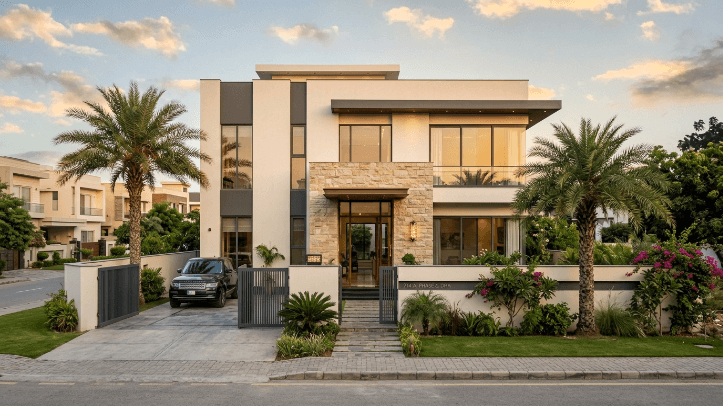
Modern Pakistani house design in 2026 has settled into a recognizable visual language: clean white-and-grey facades, large vertical windows, mixed materials (stone, wood, exposed concrete), open ground-floor plans, and rooftop terraces designed for the climate. The Spanish-villa and faux-Victorian phases of 2015-2018 are over. What replaced them is sharper, more honest, and meaningfully more practical for Pakistani weather.
This guide walks through the design moves dominating new Lahore construction in 2026, the materials that are taking over from imported substitutes, and the practical climate adaptations that separate good Pakistani houses from copy-paste imitations of Western residential design.
The defining facade language
The 2026 Pakistani house facade leans on three principles:
-
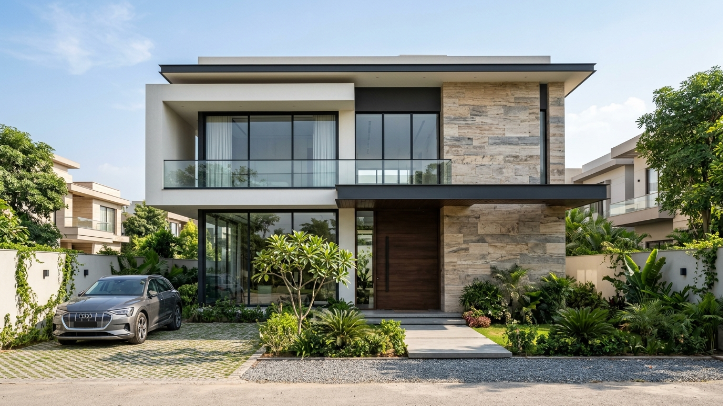
Two-tone neutral palette. Off-white plaster as the base, with charcoal or dark grey accent panels framing the entry and balconies. No bold colors. The neutral palette ages better and resists the dust staining that Pakistani urban air produces.
-
Vertical windows over horizontal. Tall narrow windows (8-12 feet tall, 2-4 feet wide) replace the earlier horizontal strip windows. They flood the interior with light, hide air conditioning units more elegantly, and read as more architectural.
-
Material contrast at entry. A different material (stacked stone, wood slat, Corten steel, fluted concrete) marks the entrance porch. This breaks the facade monotony and signals where the front door is — useful in larger 1-kanal plus houses.
Open ground floor, private upper floors
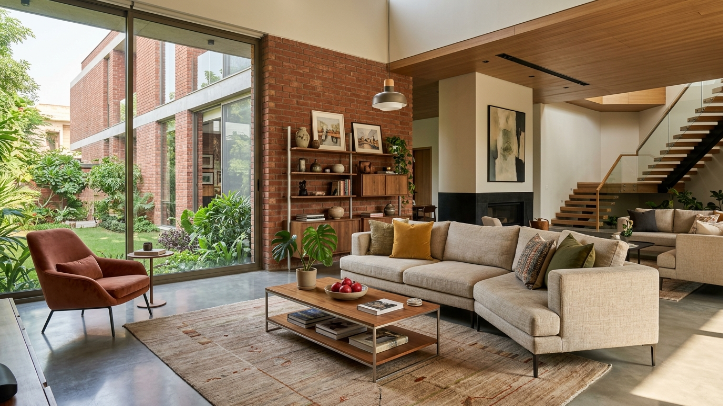
The strongest spatial shift in 2026 design: ground floor opens up into a single connected drawing-dining-kitchen-family room (often with sliding glass doors to the lawn), while upper floors remain compartmentalized bedrooms with attached baths.
This works well for Pakistani extended-family lifestyles — ground floor scales to host 30+ guests for milad, dinner parties, or family gatherings; upper floors offer privacy for individual family members. The kitchen is no longer hidden — it sits as part of the social space, usually with a sleek peninsula that doubles as serving area.
Climate adaptations that actually work
A well-designed Pakistani house in 2026 includes:
- East-west orientation for the main facade where possible (avoid full south-facing in Lahore — too harsh in summer)
- Deep overhangs above west-facing windows (450-600mm projection)
- Cross-ventilation paths through the central living area — openable windows on opposite walls
- Roof insulation with 50mm+ foam panels under the top slab (drops indoor temperature 3-5°C in summer)
- Rooftop terrace with a partial pergola for evening use
- Outdoor courtyard or light well in the center of larger plots (1-kanal+) to bring light into deep rooms
The houses that skip these adaptations look modern but feel hot. The houses that include them stay comfortable through the worst of June without running AC at full load.
Materials taking over
Five material shifts dominating 2026 construction:
- Local Margalla stone for facade accents — replacing imported Italian travertine. 60% cheaper, similar visual effect, ages better.
- Pakistani-milled engineered wood for ceilings and accent walls — replacing imported MDF.
- Exposed reinforced concrete for boundary walls and accent features — replacing plastered-and-painted finishes.
- Local clay tiles (Multan brick, Khanewal tile) for roof terraces — replacing imported ceramic.
- Black anodized aluminum for window frames — replacing white powder-coated as the default.
The shift is driven partly by import-cost pressure, partly by local supply quality finally catching up to import quality.
The kitchen revolution
Pakistani kitchens have changed more than any other room. The 2026 kitchen typically has:
- Quartz or sintered stone countertops (granite is out for new builds — too heavy, harder to install cleanly)
- Handle-less cabinetry in matte white or charcoal
- Built-in appliances (oven, microwave, dishwasher) rather than free-standing
- Tall larder pantry for bulk grocery storage
- Servant-side prep counter as a separate workspace, often in a back utility area
The "servant kitchen" pattern continues but it has merged with the modern utility room — a single back zone for dishwashing, deep prep, and laundry.
Master bath as a statement room
The master bath in 2026 has become a hero room. Walk-in showers with glass enclosures replace the old shower-curtain plus bathtub combo. Double vanities, heated towel rails, large-format porcelain wall tiles, hidden lighting under floating vanities. Total budget for a master bath upgrade in a 10-marla house typically runs PKR 8-15 lac in 2026.
What to avoid
Three design moves that look outdated within 3 years:
- Heavy decorative pillars at the entrance (Spanish-revival residue from 2010s).
- Mirrored ceiling tiles in living rooms (1990s leftover that resurged briefly).
- Painted ceiling roses and crown moldings in formal drawing rooms — replaced by clean recessed cove lighting.
For pricing context on building or buying a modern Pakistani house, see our Lahore property prices 2026 market report and house construction cost guide.